Systolic Array
A parameterised weight-stationary MAC array in SystemVerilog, with skewed input staging and a capture buffer.
- Built with
- SystemVerilog
- Source
- github ↗
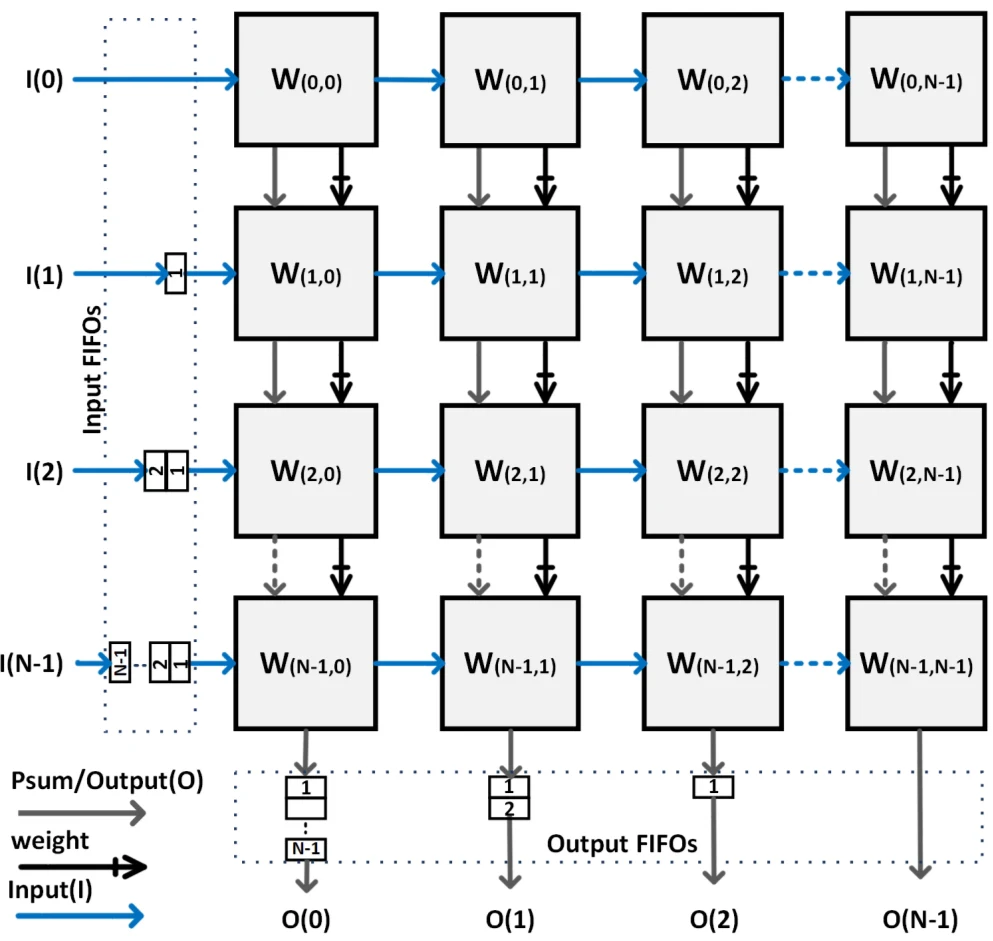
Parameterized SystemVerilog implementation of a signed, multiply-accumulate systolic array, with input skewing, output deskewing, and a controller. The default data width is 16 bits; the accumulator width scales with the array dimension to accommodate the reduction.
Architecture
rtl/pe.svimplements a processing element (PE): it stores a weight and, when enabled, multiplies the signed input by that weight and adds the incoming partial sum.rtl/systolic_array.svconnects the PEs into anNbyNarray.rtl/input_skew_buffer.svandrtl/output_deskew_buffer.svalign input and output timing across the array.rtl/controller.svsequences weight loading, computation, draining, and output deskewing.rtl/accelerator.svconnects these blocks and exposes the accelerator interface.
The RTL is parameterized by N, DATA_W, and ACC_W. ACC_W must be at least 2*DATA_W + $clog2(N) at the accelerator level.
Repository Layout
| Path | Purpose |
|---|---|
rtl/ |
Accelerator, PE, array, buffers, controller, and benchmark top-level RTL |
tb/ |
Unit testbenches and parameter sweep testbench |
scripts/ |
Windows batch scripts for simulation and Quartus builds |
constraints/ |
Timing constraints for benchmark and DE1-SoC projects |
quartus/ |
Quartus projects, benchmark results, and generated reports |
vivado/, sim/ |
Vivado and simulation project files |
python/ |
Python utilities |
Simulation
Run from a Windows command prompt or PowerShell with the Xilinx Vivado simulator commands xvlog, xelab, and xsim available on PATH:
scripts\run_accelerator_sim.batThe script compiles the RTL and testbenches, elaborates accelerator_sweep_tb, and runs the sweep. The sweep instantiates accelerator testbenches for N=2, 3, 4, 8, 16 with 16-bit data.
Quartus Benchmarks
The benchmark projects target the Cyclone V 5CSEMA5F31C6 device and build N=2, N=4, and N=8 configurations. The script compiles each project and runs Quartus timing analysis:
scripts\run_quartus_benchmarks.batThe script currently expects Quartus Lite 25.1 at C:\altera_lite\25.1std\quartus\bin64. Update QUARTUS_BIN in the script if Quartus is installed elsewhere. Generated reports are placed in quartus/output_files_n2, quartus/output_files_n4, and quartus/output_files_n8.
Quartus Results
Summary from quartus/accelerator_benchmark_results.csv:
| Device | N | PEs | ALMs | Registers | DSP blocks | M10K blocks | Post-fit Fmax (MHz) | Setup slack (ns) | Hold slack (ns) | Peak GMAC/s | Peak GOPS |
|---|---|---|---|---|---|---|---|---|---|---|---|
| 5CSEMA5F31C6 | 2 | 4 | 81 | 135 | 4 | 0 | 133.98 | 12.536 | 0.237 | 535.92 | 1,071.84 |
| 5CSEMA5F31C6 | 4 | 16 | 505 | 1,025 | 16 | 1 | 93.87 | 9.347 | 0.235 | 1,501.92 | 3,003.84 |
| 5CSEMA5F31C6 | 8 | 64 | 1,894 | 3,522 | 64 | 9 | 88.71 | 8.727 | 0.176 | 5,677.44 | 11,354.88 |
Peak throughput is calculated from the post-fit clock frequency assuming one multiply-accumulate per PE per cycle; GOPS counts a multiply and an addition as two operations. These are theoretical peak figures, not measured end-to-end workload throughput. Resource use and timing are Quartus implementation results; consult the per-configuration fit and STA reports for details.